AI Proposal Creation
Automated system where the only input for a ready-to-send proposal is a conversation.
Year
2025
Role
Product Design, Research, Build
Opportunity
Proposals were killing Justin’s week. Juggling presentations, workshops, and corporate trainings, proposals were both the least and most important items on his todo list.
No two proposals ever looked the same, and there was no standard process. Getting a usable first draft was often harder than closing the deal itself.
As an AI-first business, the question became: could we turn a single conversation into a complete, customised, client-ready proposal?
Impact
hours saved per week of repetitive writing
system with consistent structure, style, and tone of voice
My Role
Operating as researcher, architect, and developer, I owned the project from initial concept to deployment.
- •Product Strategy & Vision: Defined the core problem, mapped the ideal future-state process, and aligned automation goals with the operational workflow.
- •Technical Analysis & Architecture: Selected tools, integrations, and AI models; mapped system flow from transcript input to final stored document.
- •Development: Built the n8n workflows, OpenAI agents, integrated with HubSpot for live product/pricing data, and configured PandaDoc for automated proposal formatting and delivery.
- •Launch: Managed rollout, trained the ops team, and documented the process for long-term maintainability.
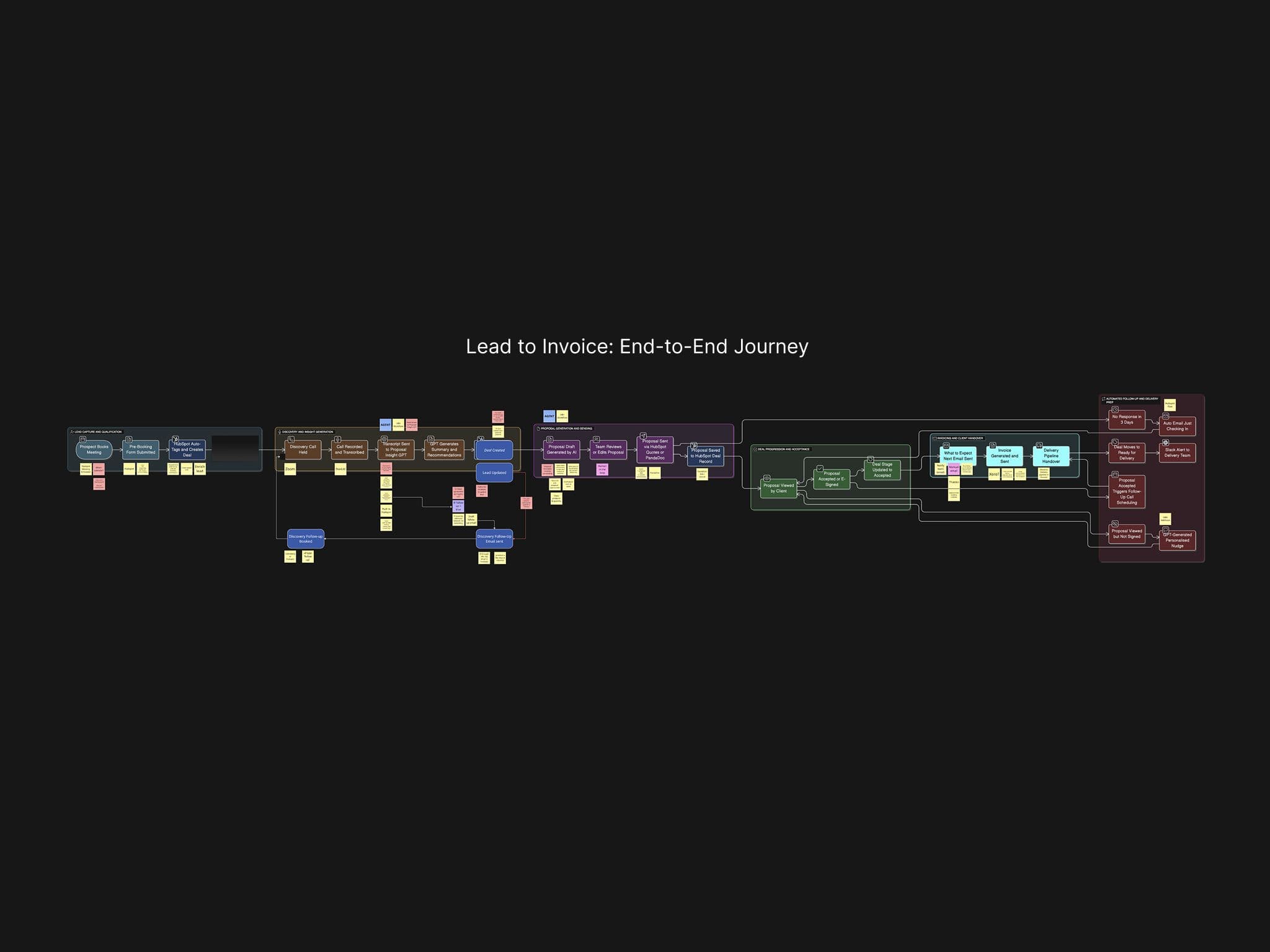
Mapping the internal process of Discovery Call > Sending a Proposal, including systems, technologies, and potential points of failure
Approach / Process
1. Mapping the Sales Journey
I charted exactly how Justin understands a client’s problem, decides what to sell, and guides the onboarding process. This mapping became both a reference document for the team and the blueprint for system design.
2. Selecting the Tech
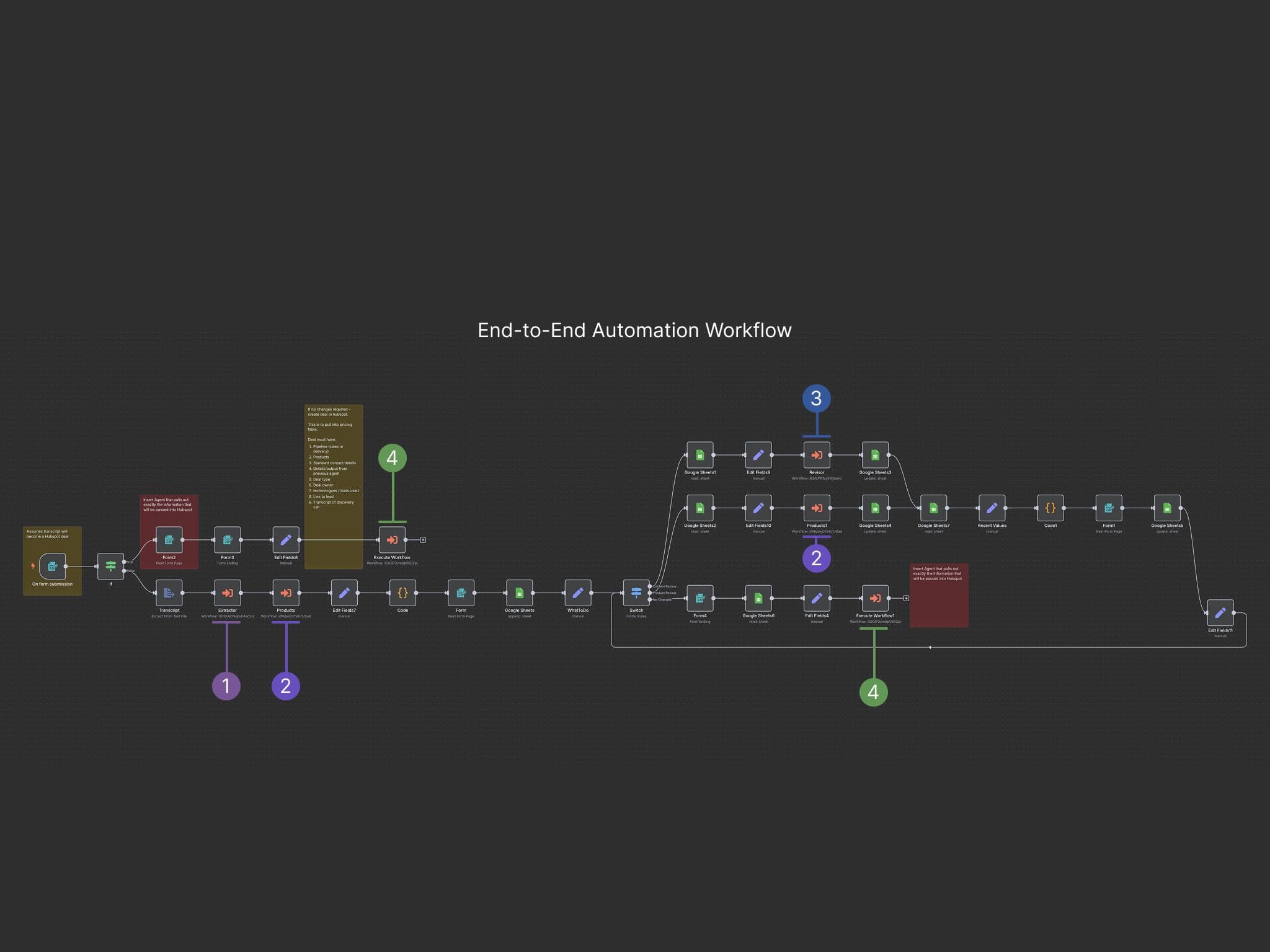
PandaDoc’s merge tags and tight HubSpot integration would make this possible. Proposals could be pre-filled with live product data, synced back to the client record, and even trigger payment workflows when signed. n8n would orchestrate the entire flow, handling user interaction, AI calls, product lookups, variable generation, and document creation in a single automated run.
3. Designing the Multi-Agent Workflow
To deliver both speed and quality, I architected a chain of specialised AI agents, each with a clear, single-minded role:
- •The Extractor Agent: Took the discovery call transcript and pulled every relevant detail for the proposal: client names, business details, the problem they wanted solved, and contextual understanding of Justin’s services. We trained it on past transcripts, proposals, and a scoped knowledge base of what Justin offers, so it could ignore irrelevant noise and focus on deal-making signals.
- •The Draft Content Writer: Took the extractor’s output and called a product workflow that pulled live product data from HubSpot. From there, it built a proposal outline tying the client’s problem to potential solutions, mapped to Justin’s processes and recommended products (including upsell opportunities).
- •The Review Agent: Entered the human-in-the-loop stage. The outline was shown to the user, who could approve or give plain-text feedback on the content, product selection, pricing, or quantities. The review agent then made the requested adjustments.
- •The Proposal Writing Agent: Using Justin’s tone of voice, this agent wrote the proposal as a set of variables, which at completion were automatically placed into a proposal template. From there, PandaDoc assembled the final, beautifully formatted, client-ready document.
4. Four-Click Delivery
The end-to-end experience became:
- 1.Open the application (n8n form for prototype).
- 2.Attach the transcript file.
- 3.Approve the proposal concept or make free-text edits.
- 4.Receive an email with a link to a live, 90% bespoke proposal.
Learnings / Reflections
Editing loops are still tricky for LLMs
Too many regenerations and requests for edits can lead to “drift” from the original, forcing more editing in an endless loop. My workaround was to save all outputs to Google Sheets before further destructive processing.
Systems are only as good as their users
During build, I discovered Justin preferred to use his own prompt style for extracting transcript information, which was highly tuned to his personal ChatGPT setup. To make this work, I added a manual input step so his custom data could feed into the content-writing LLM in a repeatable way. While the system adapted and worked, the learning was to get buy-in and establish the human process first. Automation is only as good as the human agreement around how it’s used.
This is possible for most businesses
I don’t know anyone who enjoys writing proposals; it’s busywork at its finest. Having built this system, I can see how easily it could apply across industries and significantly lift both proposal output and, by extension, close rates. Yet, I’m just not seeing it used. The question now is not how, but when.